
How IKEA Turned an AI Chatbot Into €1.3 Billion in New Revenue
Two AI strategies are playing out right now in big companies, and they are producing wildly different outcomes from the same technology.
On one side: Oracle, Meta, and dozens of other large enterprises have spent the year cutting tens of thousands of people to free up budget for AI. The thesis is straightforward — the technology replaces the humans, so reduce the headcount and pocket the difference.
On the other side: IKEA.
The Decision That Generated €1.3 Billion
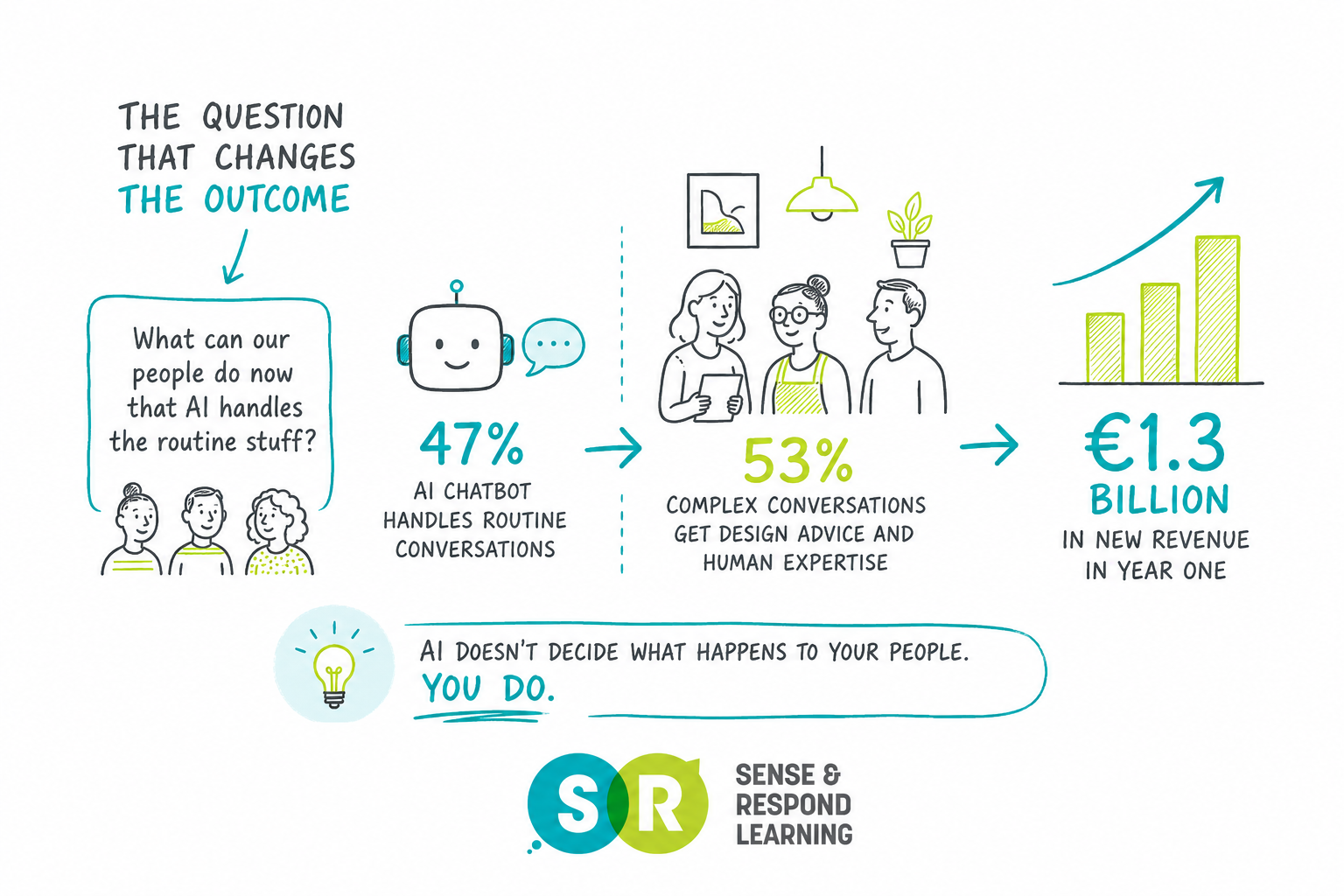
IKEA deployed an AI chatbot that now handles 47% of all customer conversations. Like every company that watches a tool absorb that much work, IKEA had a choice. The cost-cutting move would have been to read that 47% as a license to shrink the customer service team and book the savings.
They didn't.
Instead, IKEA looked at the other 53% — the conversations the chatbot couldn't handle — and noticed something most companies miss. Those conversations weren't transactional. Those customers weren't asking about order status or returns. They were asking for design advice. They wanted help making their rental flat feel more like home. They were asking the kinds of questions a transactional service org didn't have the language to answer.
So IKEA reskilled their customer service team into interior design consultants. Same people. Slightly different job description. A completely different way of creating value for the customer.
That single decision generated €1.3 billion in new revenue in its first year.
Two Questions, Two Outcomes
A large group of companies are asking the same question right now: "How do we cut costs with AI?"
IKEA asked a different one: "What can our people do now that AI handles the routine stuff?"
Same turbulent technology market. Same access to roughly the same AI capabilities. Completely different outcomes. (I shared the original observation on LinkedIn earlier this week — the short version, if you want it.)
The reason this story matters is that it makes something visible that most of the AI-strategy conversation works hard to hide: AI doesn't decide what happens to your people. You do.
The companies cutting jobs aren't being forced into it by the technology. The AI isn't issuing the layoffs. Leadership is — and they're choosing what looks, in the short term, like the cheaper and more legible move. The companies reinventing roles aren't being heroic, either. They are simply noticing a question the cost-cutters didn't ask.
What does the work look like when the routine 47% is taken care of?
The Hard Part Isn't the AI. It's the Question.
Here's what makes IKEA's move repeatable, not just admirable. They did three things that almost no other company we've seen has put together.
1. They did real discovery work. Before deciding what their customer service team should do next, IKEA paid attention to what customers were actually asking for. That isn't an AI question. That's a product management question. The conversations the chatbot couldn't handle became their best research data — better than any survey, better than any focus group, because it was unprompted, real, and at scale.
2. They aimed AI at customer outcomes, not at internal productivity. Most companies measure their AI rollouts by output — tickets resolved, faster response times, fewer staff required. IKEA measured what changed for the customer — design help, in-home guidance, problems the old org couldn't even see, let alone solve. When your measurement frame is internal productivity, AI looks like a cost-cutting tool. When it's customer outcomes, AI looks like a revenue-creation tool. Same technology, different verdict.
3. They restructured how their people collaborate. The new interior design consultants aren't doing customer service with a different job title. They're collaborating with merchandising, with design, with in-store sales — a different shape of organization entirely. The new shape only becomes possible because AI freed up the human attention the new work requires. The restructuring is the product of the AI decision, not a prerequisite for it.
Notice what's not on that list. There is no special AI tooling secret. No proprietary model. No celebrity hire. They did not appoint a chief AI officer or buy a new platform.
They asked a better question about what their people could do — and then they organized the company to answer it.
What Modern Product Management Looks Like
This isn't a parable. It's a method. At [Sense & Respond Learning](https://senseandrespond.co), this is exactly what our workshops train product organizations to do:
- Identify value-creation opportunities with customers through discovery work — the way IKEA noticed the 53% before deciding what to do with it.
- Put AI tools to work developing better solutions for customers — not just faster output of the same work, but new solutions the team couldn't have built before.
- Restructure how people collaborate so the team and the business become exponentially more successful together — not just individually more productive.
That's modern product management. It's what closes the gap between AI capability and customer value.
And it's what we teach.
If your organization is in the middle of an AI investment cycle and wondering what to do with all of it, our workshops are built around the IKEA-style question: what can our people do now that the routine is handled?
We'd love to talk.
---
Jeff Gothelf is co-founder of Sense & Respond Learning and co-author of Lean UX*,* Sense & Respond*, and* Who Does What By How Much?*. He has led product and design teams across half a dozen industries and writes regularly about AI, product management, and the human side of building.*