Training built for the problems AI teams are actually facing.

Real-World Training for Teams Doing Real AI Work

TRAINING BUILT FOR REAL WORK

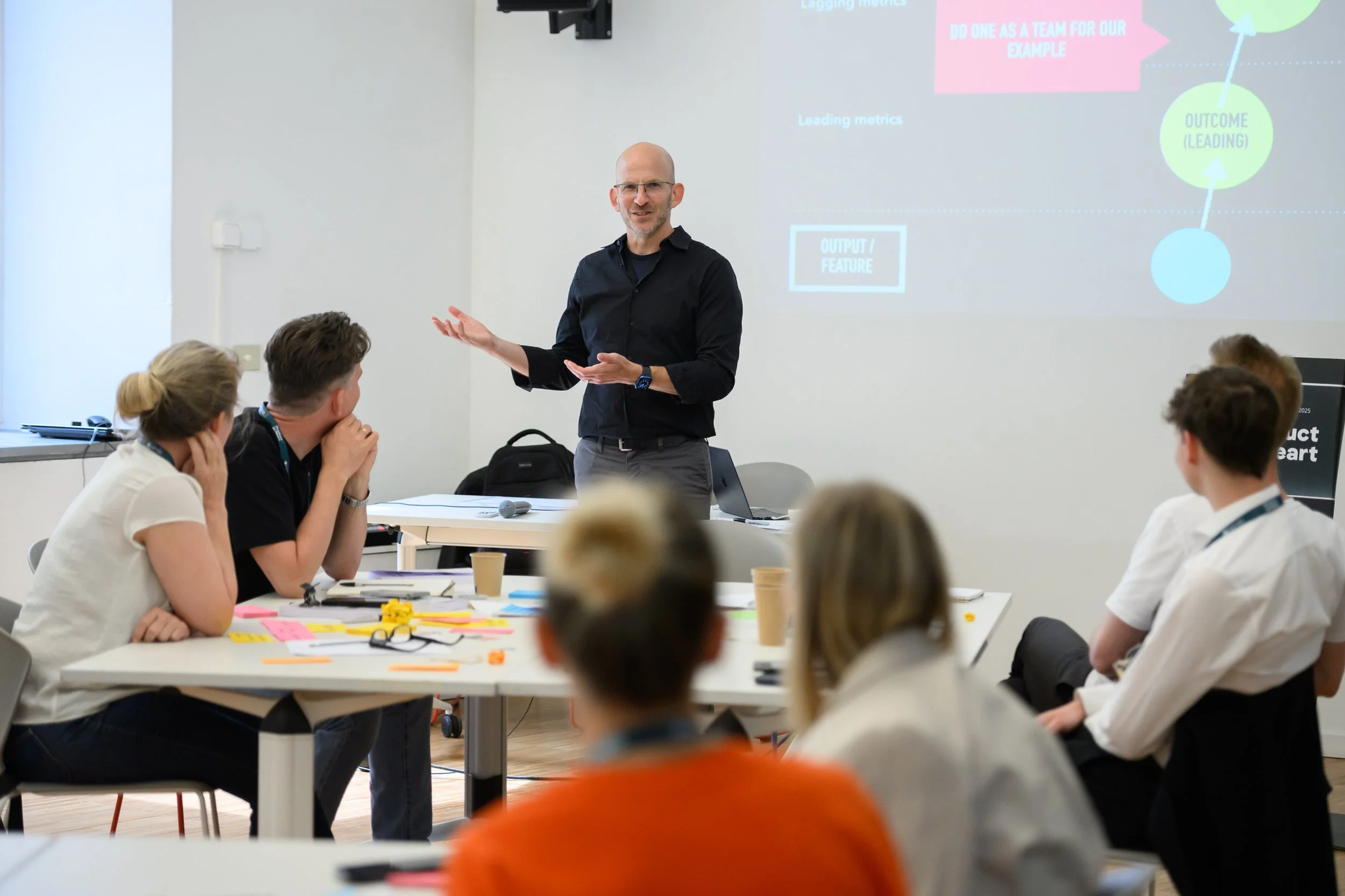
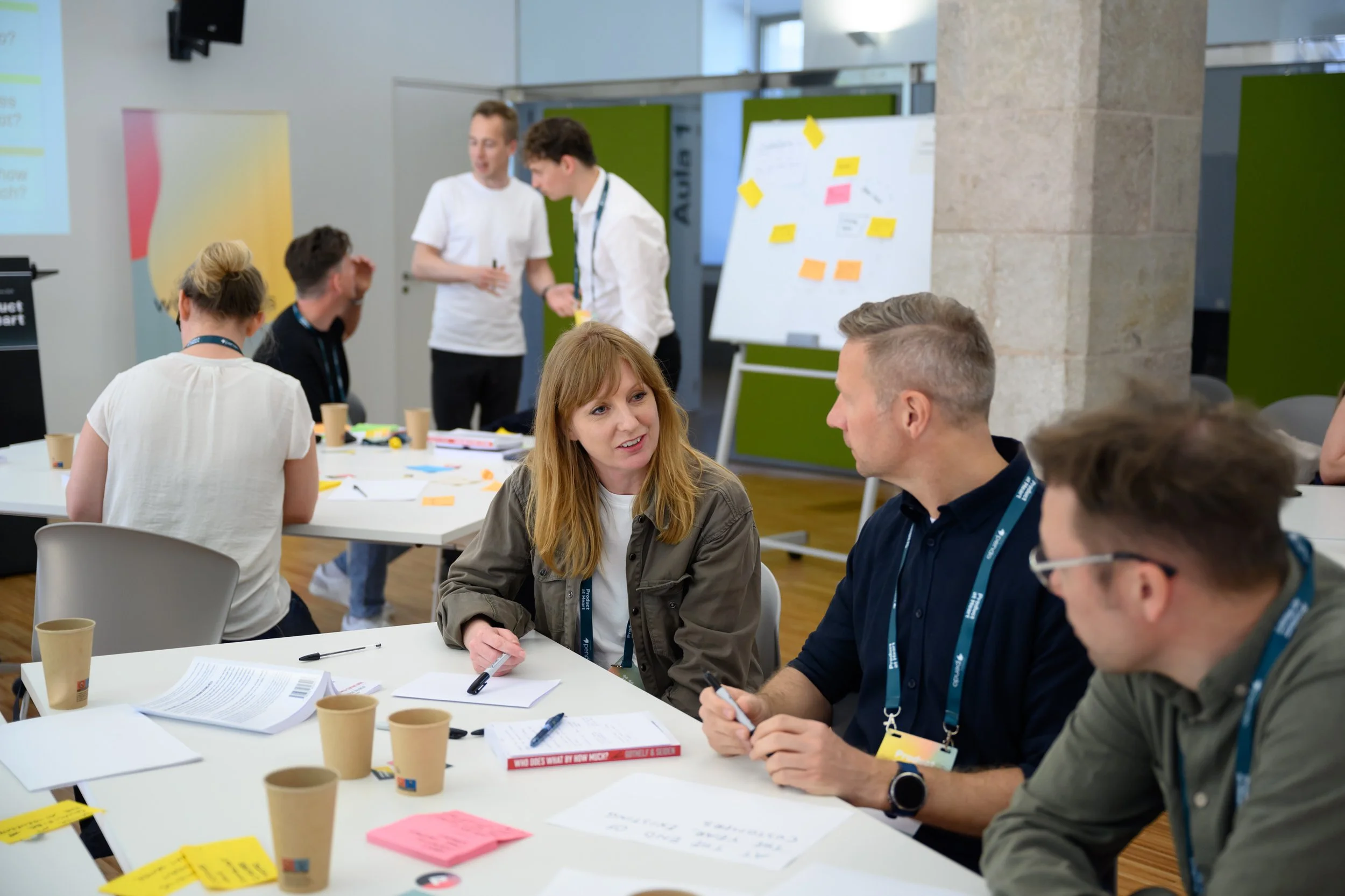
We don't just teach theory. We are practitioners, and our workshops, courses, and talks are built around real challenges, not hypothetical examples. You bring your actual work into the room: the AI initiative that's stalled, the strategy that keeps shifting, the stakeholders who don't understand what you're building. We help you move it forward, using proven frameworks your team can apply immediately.

LEAN PRODUCT SEQUENCE

Four courses that build a complete product practice. Start with strategy. Move through discovery and delivery. Finish with the organizational changes that make it stick. AI teams and product teams use this sequence to connect their work to what customers actually need.
AI COURSES

Two courses built specifically for the AI era. One teaches product managers to use AI as a thinking partner without losing their judgment. The other teaches teams how to build AI products that create real customer value, not just impressive demos.
BEYOND PRODUCT DEVELOPMENT

Three courses for the whole organization. Outcomes Over Output introduces outcome-based thinking. Customer-Centric OKRs extends it to goal-setting. Storytelling Superpowers gives every team the skills to communicate their work in ways that earn support.
11,500+ Professionals Trained Worldwide

Flexible Formats That Fit Your Team

TRAINING BUILT FOR REAL WORK

All our workshops and courses are available in person and online. We offer live, interactive sessions that can be delivered on-site or remotely, wherever your team is located. Our programs are created by Jeff Gothelf and Josh Seiden and led by our Certified Training Partners worldwide.

WORKSHOPS

SELF-PACED COURSES

TALKS & KEYNOTES

IN-HOUSE TRAINING

Our Training Topics

LEAN PRODUCT SEQUENCE

Lean Product Strategy

TURN STRATEGY INTO CLEAR CHOICES YOUR TEAM CAN ACT ON

Strategy in most organizations is treated as a planning exercise. Teams spend weeks writing plans that are out of date before the work begins. AI Transformation has made this harder. Strategy can shift in months, not years. This course teaches a different approach. Using the Lean Strategy Canvas, participants turn strategy into a set of clear choices and testable hypotheses. They leave with a strategy they can act on, measure, and update as they learn.

LEARNING GOALS

  • Use the Lean Strategy Canvas to set a clear direction for the next 12-24 months

  • Identify the obstacles that stand between your team and your goal

  • Make explicit choices about where to focus and where not to

  • Set OKRs that measure whether your strategy is working

  • Treat strategy as a hypothesis and design the work to test it

  • Connect strategy to the daily work of your team

Lean Product Discovery

FIND OUT WHAT CUSTOMERS ACTUALLY NEED BEFORE YOU BUILD

Most teams build what they think customers need. They're often wrong. Lean Product Discovery teaches teams to find out what customers actually need before committing to a build. This is especially important for AI teams, which often have strong technical skills but lack the product methods to check whether their work creates real value for customers. Using the Lean Product Canvas as a shared framework, participants work through the full discovery process on their real initiatives: from defining the business problem to mapping outcomes, to generating and testing solution hypotheses. Every exercise uses the team's own work, so participants leave with new skills and real progress.

LEARNING GOALS

  • Define a clear business problem, starting from outcomes rather than features

  • Map user outcomes and identify the behaviors that signal success

  • Write and prioritize product hypotheses

  • Design experiments to test assumptions before building

  • Build an outcome-based roadmap that connects strategy to delivery

  • Conduct lightweight customer research to validate Assumptions early

Lean Product Continuous Learning and Delivery

RUN DISCOVERY AND DELIVERY AS ONE CONTINUOUS PRACTICE

Discovery and delivery are often treated as separate phases. This course shows teams how to run both in parallel. For AI teams, this is especially valuable. What you learn from early users often changes what you build next, and a continuous learning loop is what keeps AI products improving over time. Participants learn to build outcome-based roadmaps, manage backlogs around outcomes rather than features, and use experiment stories to connect what they're building with what they're learning. This course is offered as an optional half-day add-on to Lean Product Discovery.

LEARNING GOALS

  • Run discovery and delivery as one continuous practice within a single team

  • Build and maintain an outcome-based roadmap

  • Manage a backlog around outcomes, not features

  • Use experiment stories to connect delivery work to learning goals

  • Track progress in terms that leadership and stakeholders understand

Lean Product Organizations

BUILD THE ORGANIZATION YOUR AI TRANSFORMATION REQUIRES

Building a great product organization is hard. Most leaders are trying to change how their teams work without a clear model for what "better" looks like, or how to get there. AI Transformation has made this harder. Leaders are being asked to build AI-capable organizations without a clear model for what that looks like. Lean Product Organizations is a multi-week working program for leaders. It's not a lecture. Each session, participants bring a real organizational challenge, define success in terms of outcomes, design a minimum viable experiment, and assign owners. The next session starts with a review of what was learned.

LEARNING GOALS

  • Identify the specific organizational challenges that slow your team down

  • Define success for organizational change in terms of measurable outcomes

  • Design minimum viable process experiments to test new ways of working

  • Assign clear owners and track progress week to week

  • Build a continuous improvement practice that your team can sustain on its own

AI COURSES

AI Skills for Lean Product Managers

USE AI AS A THINKING PARTNER, NOT JUST A FASTER WAY TO WRITE

AI tools are changing how product managers work. But most teams use AI without a framework for where it helps, where it doesn't, and what it gets wrong. This course teaches product managers to use AI as a thinking partner throughout the product development process. The key idea: everything AI produces is an untested assumption. This course teaches you to verify, refine, and build on AI output rather than accept it. Participants leave with a personal AI toolkit built around the Lean PM AI Operating System.

LEARNING GOALS

  • Apply the core mindset shift: AI has changed the risk profile of product work, and clarity, validation, and customer value matter more than ever

  • Use AI to speed up business problem definition and opportunity analysis

  • Create and refine proto-personas with AI before conducting human research

  • Use AI to spot risks in product plans before they become problems

  • Apply AI to rapid prototyping and solution brainstorming

  • Build your own personal AI toolkit using the Lean PM AI Operating System

Building AI Products with Lean Product Management

CONNECT YOUR AI TECHNICAL WORK TO REAL CUSTOMER VALUE

Building AI products raises challenges that standard product methods don't fully address. This course teaches teams to apply Lean Product Management methods to AI product development, with specific attention to where AI products are different. The starting point: the fundamentals of good product work hold, even for AI. Customer value, clear outcomes, and tested assumptions matter more, not less, when the technology behaves in ways that are hard to predict.

LEARNING GOALS

  • Apply the Lean Product Canvas to AI product development

  • Decide whether AI is the right approach for a given problem

  • Define success metrics for AI systems that don't always produce predictable outputs

  • Plan a gradual capability rollout that builds user trust over time

  • Design evaluations and experiments for AI features

  • Connect AI technical work to measurable customer and business outcomes

BEYOND PRODUCT DEVELOPMENT

Outcomes Over Output

MEASURE WHAT CHANGES, NOT JUST WHAT YOU SHIP

Most organizations measure what they build. This course teaches them to measure what changes because of what they build. This shift is especially important in AI Transformation, where it's easy to measure technical performance instead of customer value. Outcomes Over Output introduces the shift from output thinking to outcomes thinking, and gives participants a practical framework for defining outcomes, connecting them to business goals, and using them to make better decisions. It's a strong starting point for any team that's new to outcome-based thinking.

LEARNING GOALS

  • Explain the difference between outputs and outcomes in plain language

  • Define meaningful outcomes for your team's work

  • Connect outcomes to the business goals they support

  • Use outcomes to make better decisions about what to build

  • Build support for outcome-based practices in your team or organization

Who Does What By How Much: Customer-Centric OKRs

SET GOALS THAT HOLD UP EVEN WHEN STRATEGY SHIFTS

OKRs are one of the most widely used goal-setting tools in the world and one of the most widely misapplied. Most teams use OKRs to track output. This course teaches teams to use OKRs to measure real change in the behavior of the people they serve. In AI transformation, where strategy can shift every few months, OKRs built around customer behavior change are the most resilient way to set goals. Based on the best-selling book by Jeff Gothelf and Josh Seiden, this course teaches everyone in the organization, not just product and engineering, to write goals grounded in customer behavior change. Teams leave knowing not just how to write OKRs, but why they work and how to build a lasting practice around them.

LEARNING GOALS

  • Define who your customer is, regardless of your role in the organization

  • Understand the difference between outputs and Outcomes and why it matters for goal-setting

  • Write OKR statements grounded in customer behavior change

  • Build a continuous OKR practice that stays relevant as strategy changes

  • Align the whole organization around goals everyone can understand and act on

Storytelling Superpowers for Persuasive Conversations

MAKE EVERY PRESENTATION CLEAR, STRONG, AND UNFORGETTABLE

Most people are never taught how to communicate their work clearly. The result is presentations that inform but don't persuade, ideas that get lost, and support that's never built. This is especially urgent for teams working through AI Transformation, where technical work is hard to explain, and stakeholder support can determine whether a project continues. This hands-on workshop teaches participants the core principles of clear, compelling communication and gives them tools they can use the next day. Using a mix of short lectures, video examples, and live practice, participants learn to structure their ideas, engage their audience, and make a strong case for what they need.

LEARNING GOALS

  • Understand the basic principles of a "story"

  • Know how to structure a presentation

  • Understand how and why to add humor to your presentations

  • Become a compelling storyteller

  • Get your point across clearly, even with a complex or technical topic

  • Influence colleagues without authority

  • Be more confident in your presentations

NOT SURE WHERE TO START?

Use our chatbot to find the right training for your team's AI challenges or contact us directly. We're happy to help you figure out the best fit.

Trusted by Teams Navigating AI Transformation

SUCCESS STORIES

NICOLE GERHARDT
CHIEF HUMAN RESOURCES OFFICER, TELEFÓNICA DEUTSCHLAND HOLDING AG

“Jeff Gothelf is a true agility expert: a great teacher, storyteller and consultant. He worked with our entire top and middle management to evolve agility thinking in our organization. He provided the ground for improved cross- functional collaboration and outcome orientation.”

Frequently Asked Questions

  • The core topics of our workshops and courses are Product Discovery & Lean UX, Lean Product Management, Objectives & Key Results and Storytelling for Great Presentations. We are always evolving and adding new workshops to our offerings.

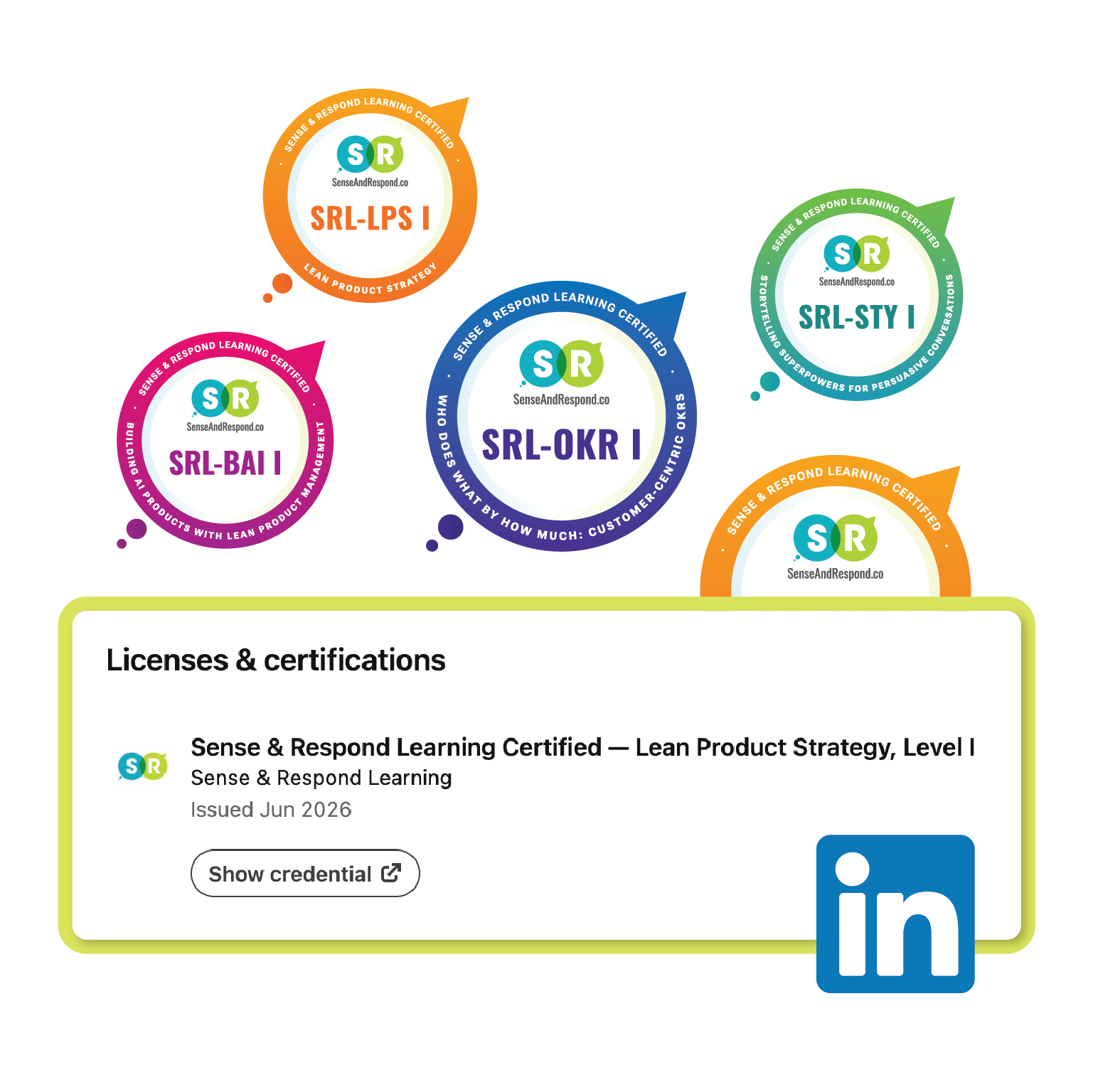
  • Yes. We offer certificates of completion for each  of our courses.

  • We can train groups from 5 to 500 people.

  • Depending on the course, training can range from a 90-minute workshop to multi-day, hands-on sessions. For larger and more complex organizations we also offer multi-week learning journeys that blend instruction, practice and coaching.

  • We’ll guide you through everything. We recommend starting by identifying the teams or roles of the people attending. Then ensure they have access to the required tools and come prepared with an area of work they’d like to improve. This will make the training more practical and relevant.

  • We use Mural and Zoom

  • We offer both. While most of our programs run online for global teams, we also provide in-person workshops and customized training for organizations upon request.

  • Yes. Several of our core courses are available in a self-paced format, and we continue to expand that library so teams can learn on their own schedule.

  • Yes. We can deliver training in several languages through our global network of instructors. Let us know your language needs and we’ll match you with the right trainer.

  • We don't just teach theory. We teach from experience. Our workshops, courses and talks focus on real-world challenges because we've done the work. We're practitioners first and have the experience (and scars) to prove it.

  • Yes! We’re practitioners, we’ve done this work. It’s not hypothetical, we’ve created OKRs in action and led teams that have worked this way. Contact us to explore how we can help.

  • We work with a global network of Certified Training Partners. Experienced coaches, trainers and practitioners who deliver our courses in multiple time zones and languages. Our CTPs are trained in our proven methodologies and use our expert-designed materials to deliver high-impact, hands-on learning.

    This model lets us bring world-class, customer-centered training to teams around the world while keeping the quality and approach we’re known for.

  • Of course we can. AI is a powerful technology, and we’re excited to help teams learn how to use it effectively so it actually returns on investment and does the things you need it to do. Our approach always starts with the fundamentals: staying customer-centric, solving real problems and sensing and responding our way to the best solution.

    Sometimes AI is the right answer and sometimes it isn’t. We teach teams how to figure that out and how to deploy AI in ways that create meaningful value. So yes—the answer is absolutely yes—and it reflects the core of our philosophy.

  • Yes. We have built and delivered multi-cohort, multi-year training programs for large organizations, reaching thousands of employees. We tailor programs to your goals, structure and scale. To begin, contact Aida at aida@senseandrespond.co and we’ll get back to you ASAP.

  • We’ve worked extensively in regulated environments, including financial services, pharma, health care, government, infrastructure and cannabis. We understand compliance requirements and know how to help teams work effectively within those constraints.

  • African or European? (A reference from Monty Python and the Holy Grail.)

These are the most common questions we hear as people are selecting training for themselves or their teams. If you don’t see your question answered here, please get in touch with us.

Let's Learn Together

Whether you're leading an AI initiative or an individual building skills for the AI era, we're here to help.