AI as a Discovery Engine: Using Language Models to Accelerate Assumption Testing
Product discovery has always had a time problem. The research activities that produce the most reliable insights — user interviews, prototype testing, behavioral analysis — are time-consuming. A typical discovery sprint that includes recruiting, interviewing, synthesis, and decision-making takes two to three weeks from first question to actionable finding. In a two-week sprint cycle, discovery that takes three weeks is discovery that always arrives a sprint late. The practical consequence is that most teams under-invest in discovery relative to what rigorous product decision-making would require, because discovery cannot keep pace with the sprint rhythm that delivery demands.
Large language models are changing this calculation. Not by replacing the qualitative human insight that makes discovery valuable, but by compressing the parts of the discovery process that were previously bottlenecks: generating hypotheses from sparse signals, synthesizing large volumes of research data, identifying assumption patterns across multiple sources, and creating initial research instruments quickly. Product managers who learn to use AI as a discovery accelerator — rather than as a discovery replacement — can run more rigorous discovery within the same sprint cadence, without sacrificing the human judgment and user contact that define high-quality product decisions.

The outcome filter triage process ensures AI-generated ideas enter the backlog with behavioral hypotheses attached
Where AI Adds Genuine Value in the Discovery Process
AI's contribution to product discovery is most valuable at the bookends of the process: hypothesis generation at the beginning, and synthesis at the end. At the hypothesis generation stage, language models can rapidly produce assumption inventories from a product brief — generating the implicit beliefs about user behavior, market dynamics, and technical feasibility that the product idea depends on. A prompt that provides context about a proposed feature and asks the model to list the ten most dangerous assumptions embedded in it will typically produce a more comprehensive list than a team working from memory alone, in a fraction of the time. This output is not a replacement for team discussion — it is a starting point that ensures the discussion is comprehensive rather than limited to whatever assumptions happen to surface in a thirty-minute planning meeting.
At the synthesis stage, AI can process research data at a speed and volume that manual synthesis cannot match. Interview transcripts, survey responses, customer support tickets, and user behavior logs all contain signals relevant to product decisions — but synthesizing these signals across large volumes of data manually is slow enough that teams routinely make do with smaller samples than they should. Language models can summarize, theme, and identify patterns across large research datasets quickly, allowing PMs to base their synthesis on broader evidence bases than manual processes permit. The critical discipline is maintaining human judgment in the interpretation step: the model identifies patterns, but the PM evaluates which patterns are meaningful, which are artifacts of the data collection process, and which should change the product direction.
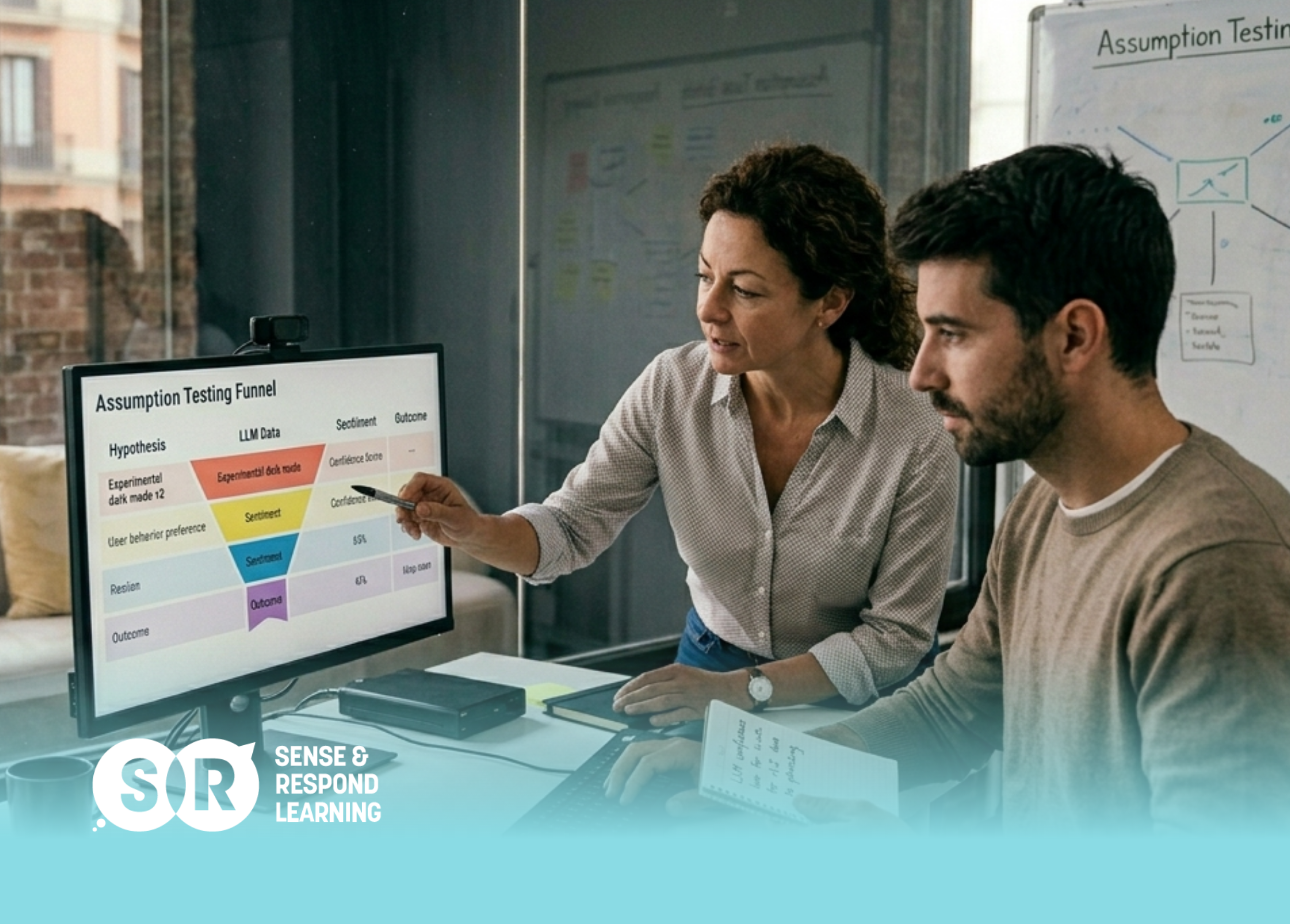
Shared AI exploration sessions prevent the feature advocacy dynamic that individual AI use creates.
Using AI to Generate and Stress-Test Hypotheses
One of the most productive AI-assisted discovery practices is using language models as hypothesis stress-testers. Once a team has written a product hypothesis — 'We believe that allowing users to set a weekly spending cap will increase the percentage of users who stay within their budget by 40%' — the model can be prompted to generate plausible counterarguments: reasons the hypothesis might be wrong, alternative explanations for the problem the feature is designed to solve, and edge cases the team has not considered. This adversarial use of AI does not replace critical thinking — it augments it, by generating the counter-perspectives that a team of people who have been working on the same problem for weeks may have stopped being able to see.
A more structured version of this practice is the 'pre-mortem' prompt: asking the model to assume that the feature shipped, failed to move the target metric, and explain what most likely went wrong. This prompt consistently surfaces assumption gaps — places where the feature's success depended on a user behavior that was never validated, or a technical integration that was never tested. Pre-mortem outputs should be treated as a supplementary input to assumption mapping workshops, not as a replacement for them. The human team's collective knowledge of the specific product, user context, and competitive environment will always exceed the model's general knowledge — but the model's ability to generate failure scenarios quickly and comprehensively adds a perspective the team would otherwise have to generate through more time-intensive facilitated exercises.
The Limits: What AI Cannot Replace in Discovery
The most important discipline in AI-assisted discovery is understanding what AI cannot do, and ensuring those activities receive genuine human investment rather than being inadvertently displaced. Language models cannot observe user behavior. They can summarize descriptions of user behavior, but they cannot watch a user struggle with a prototype and notice the specific moment of confusion that reveals a mental model mismatch. The visceral, context-rich insight that comes from direct user observation is not replicable by any AI tool currently available — and it is precisely this insight that most reliably changes how product teams think about the problems they are solving.
Language models also cannot validate assumptions against actual user behavior. A model that generates a prediction about how users will respond to a feature is generating a prediction based on patterns in text data, not on empirical observation of the specific users this product serves. Assumptions validated only through AI-generated synthesis are not validated — they are confirmed against the model's priors. The behavioral outcome framework that Lean UX prescribes requires actual behavioral measurement: running experiments with real users and observing what they actually do. AI accelerates the path to the experiment; it does not replace the experiment.
The Bottom Line
AI-assisted discovery is faster discovery, not different discovery. The principles that make discovery valuable — hypothesis-based thinking, assumption identification, behavioral outcome measurement, direct user contact — remain unchanged. What AI changes is the throughput of the activities that support those principles: more hypotheses generated per hour, larger datasets synthesized per day, more comprehensive assumption inventories produced per meeting. Product managers who invest in learning to use these tools well will be able to run more rigorous discovery within the same sprint cadences that delivery requires. That combination — discovery rigor and delivery speed — is the product management advantage that AI makes possible.
Related Posts from Sense & Respond Learning
The Infinite Machine Problem: When AI Can Ship Everything, How Do You Decide What's Worth Building?
Synthetic Users: How to Run AI-Simulated Customer Interviews (and When Not To)
Assumption Mapping Workshops: Getting the Whole Team Aligned Before You Build
The 'Feature Fake': Testing Demand Without Wasting Engineering Time
Further Reading & External Resources
Lean UX — Gothelf & Seiden (O'Reilly) — The foundational discovery framework that AI tools accelerate but cannot replace
Continuous Discovery Habits — Teresa Torres — Weekly discovery habit system that AI tools integrate into naturally
The Mom Test — Rob Fitzpatrick — The irreplaceable guide to human discovery conversations that AI cannot simulate
Want to go deeper? This post is part of the Sense & Respond Learning resource library — practical frameworks for product managers, transformation leads and executives who want to lead with outcomes, not outputs.
Explore the full library at https://www.senseandrespond.co/blog