
Estimating in Uncertainty: How to Give Honest Estimates Without Losing Stakeholder Trust
Software estimation is one of the most persistently dysfunctional practices in engineering. The dysfunction has a familiar shape: stakeholders request a date, engineers provide a best guess, the best guess becomes a commitment, the commitment becomes a deadline, and the deadline is missed for reasons that were foreseeable but not incorporated into the original estimate.

Saying No to a Bad Requirement: An Engineering Lead's Framework for Constructive Pushback
Engineering leads occupy an unusual position in the product organization. They are the last line of defense against requirements that are technically impossible, technically inadvisable, or technically correct but product-counterproductive.

Getting Developers to Care About Users: The Power of 'Exposure Hours'
The empathy gap between designers and engineers is one of the most consistent sources of product quality problems in software teams. Designers who regularly talk to users develop intuitions about user behavior, pain points, and mental models that shape every decision they make — from information architecture to error message wording to the sequencing of multi-step workflows.
Design Systems as Products: Treating Your Internal Tools Like External Software
Design systems have become one of the most significant investments in modern product organizations. A well-maintained design system — a shared library of components, patterns, tokens, and guidelines that product teams draw on to build consistent user interfaces — reduces design and engineering duplication, speeds up feature development, and creates a coherent user experience across a complex product surface.

Facilitating a 'Design Studio': Getting Your Whole Team to Sketch Solutions
Design is not the exclusive domain of people with 'Designer' in their title. This is one of the most important and least internalized principles in Lean UX. When a product team treats design as something that happens in a separate room, by a separate person, before being handed to the team for execution, two things go wrong: the team loses the diversity of perspective that produces genuinely creative solutions, and the people who ultimately build the product develop no ownership over the design decisions they are executing.

Coaching the 'Definition of Done': Why Output Completion Is Not Enough
In most agile teams, 'done' means the same thing: the code is written, the tests pass, the pull request is reviewed and merged, and the feature is deployed to the staging environment. This is a reasonable definition of technical completion. It is not a sufficient definition of value delivery.
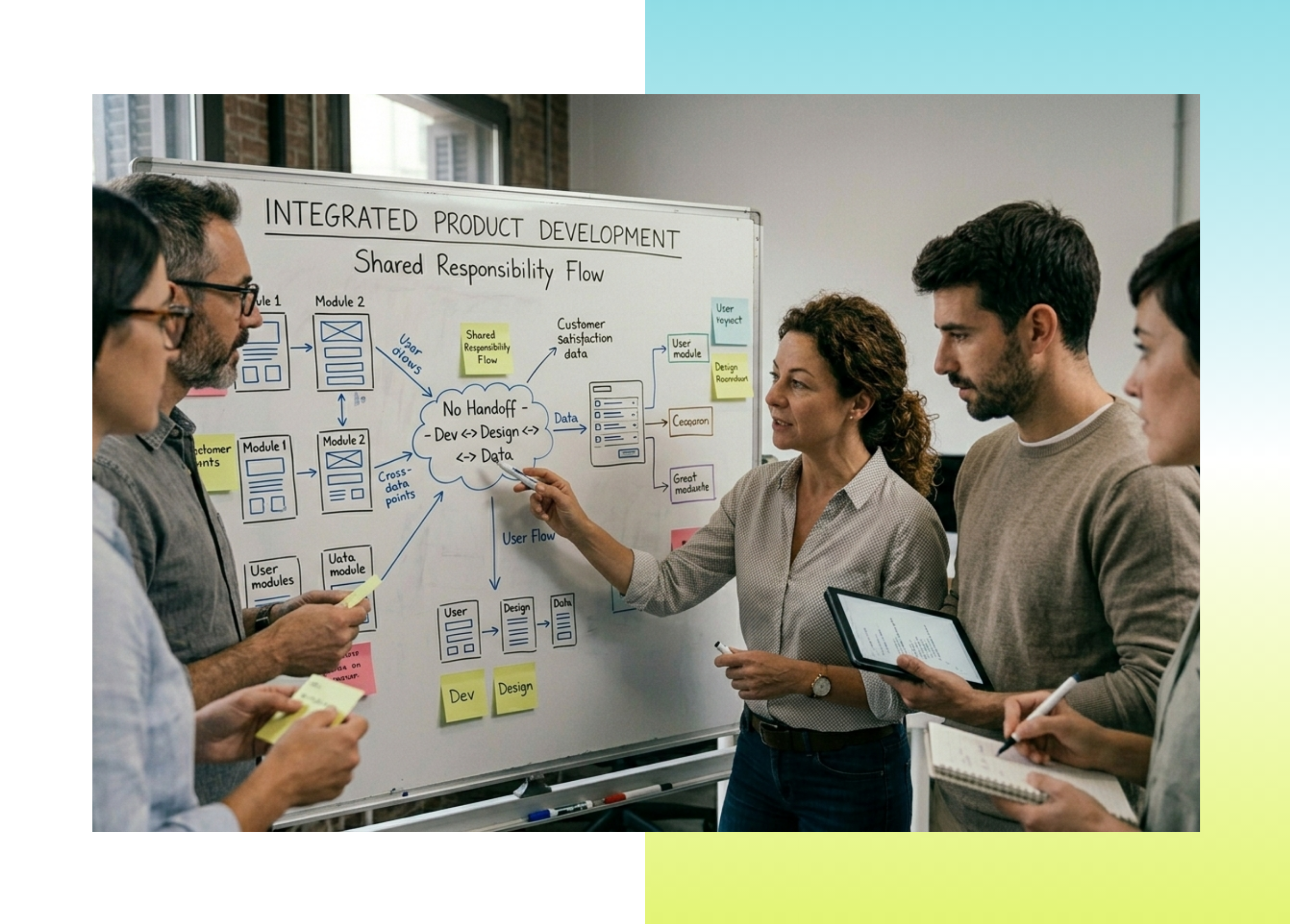
The Death of the Handoff: Why 'Over the Wall' Design Is Failing
The handoff is a ritual that every designer who has worked in a product organization knows intimately. You spend days or weeks creating detailed specifications — annotated wireframes, interaction flow documents, component-level design files with red-lines and spacing notes — and then you hand all of it over the wall to engineering.

Building a Culture of Learning: How Product Leaders Create Psychological Safety for Failure
Lean UX is built on a premise that most organizations find genuinely difficult: that teams should be rewarded for learning, not just for delivering. Learning requires failure — not strategic failure, not execution failure, but the productive failure of a well-designed experiment that produced an unexpected result.
Cross-Functional Team Health: The Signals Every Agile Coach Should Monitor
In agile coaching, team health is both a leading indicator and a lagging one. It is a lagging indicator because the team's current health reflects the cumulative effect of past decisions — about how the team was formed, how work is structured, how leadership behaves under pressure, and whether the organization's stated commitment to agile practice is matched by its actual governance decisions.

The CPO as Chief Experimenter: Modeling a Learning Culture from the Top
Culture follows behavior. This is the most important and most frequently ignored principle in organizational change management. Product leaders who want their organizations to run experiments, embrace failure as learning, and make evidence-based decisions routinely attempt to create this culture through proclamations, process mandates, and values statements.

Coaching Upward: How to Get Executives to Support Agile Transformation
The most common reason agile transformations fail is not that teams cannot learn agile practices. Teams adapt quickly — the ceremonies, the frameworks, the vocabulary are learnable within a few sprints. The reason transformations fail is that the organizational context in which teams operate does not change. Funding models remain project-based, which means teams are measured against delivery schedules rather than outcomes.

CI/CD as a Learning System: How Continuous Delivery Enables Faster Product Experiments
Continuous integration and continuous delivery are typically discussed as engineering efficiency tools: faster deployment cycles, reduced integration risk, shorter feedback loops between code commit and production environment. These are genuine benefits. But engineering leads who frame CI/CD exclusively as a delivery speed tool are underselling its strategic value.

The Case Against Annual Roadmaps: Why Quarterly OKRs Serve Leaders Better
Every year, product leaders spend weeks producing annual roadmaps that are outdated before they are published. The process is familiar: gather requirements from sales, customer success, and executives; align with engineering on feasibility; produce a timeline that commits to delivering Specific Feature A in Q2, Feature B in Q3, and Feature C in Q4.
Assumption Mapping Workshops: Getting the Whole Team Aligned Before You Build
Every product initiative is built on a stack of assumptions. Some are explicit — the team has named them and chosen to proceed despite uncertainty. Most are implicit — beliefs about user behavior, technical feasibility, market conditions, and business viability that nobody has articulated because they feel too obvious to question, or too uncomfortable to name.
From Requirements Gathering to Assumption Declaring: A Mindset Shift
Requirements gathering is one of the foundational rituals of software product development. A product manager or business analyst conducts interviews with stakeholders, synthesizes the outputs into a requirements document, and hands that document to the design and engineering team as the specification for what to build.
The Anti-Pattern Library: 10 Agile Dysfunctions and How to Coach Through Them
Every experienced agile coach develops an internal library of dysfunctions — the recurring patterns of broken practice that appear in team after team, organization after organization, regardless of industry or company size. The details vary, but the shapes are remarkably consistent.