
The Death of the Handoff: Why 'Over the Wall' Design Is Failing
The handoff is a ritual that every designer who has worked in a product organization knows intimately. You spend days or weeks creating detailed specifications — annotated wireframes, interaction flow documents, component-level design files with red-lines and spacing notes — and then you hand all of it over the wall to engineering. The developers take your documents into their sprint, try to interpret your intent from the artifacts you produced, and build something. When the build does not match what you designed, you are not sure whether to attribute the gap to incomplete documentation, misinterpretation, or constraints that engineering discovered after the handoff that nobody communicated back to design.
The handoff is not a process failure. It is a symptom of a structural assumption: that design and engineering are sequential activities performed by separate groups who need formal documentation to transfer knowledge between them. In a waterfall world where phases were explicitly separated, this assumption was at least internally consistent. In an agile world where cycles are short, requirements are fluid, and cross-functional collaboration is supposed to be the norm, the handoff is a form of organizational incoherence. Jeff Gothelf and Josh Seiden's Lean UX argues that the goal of the design process is not to produce better handoff documents — it is to build the shared understanding that makes handoff documents largely unnecessary.
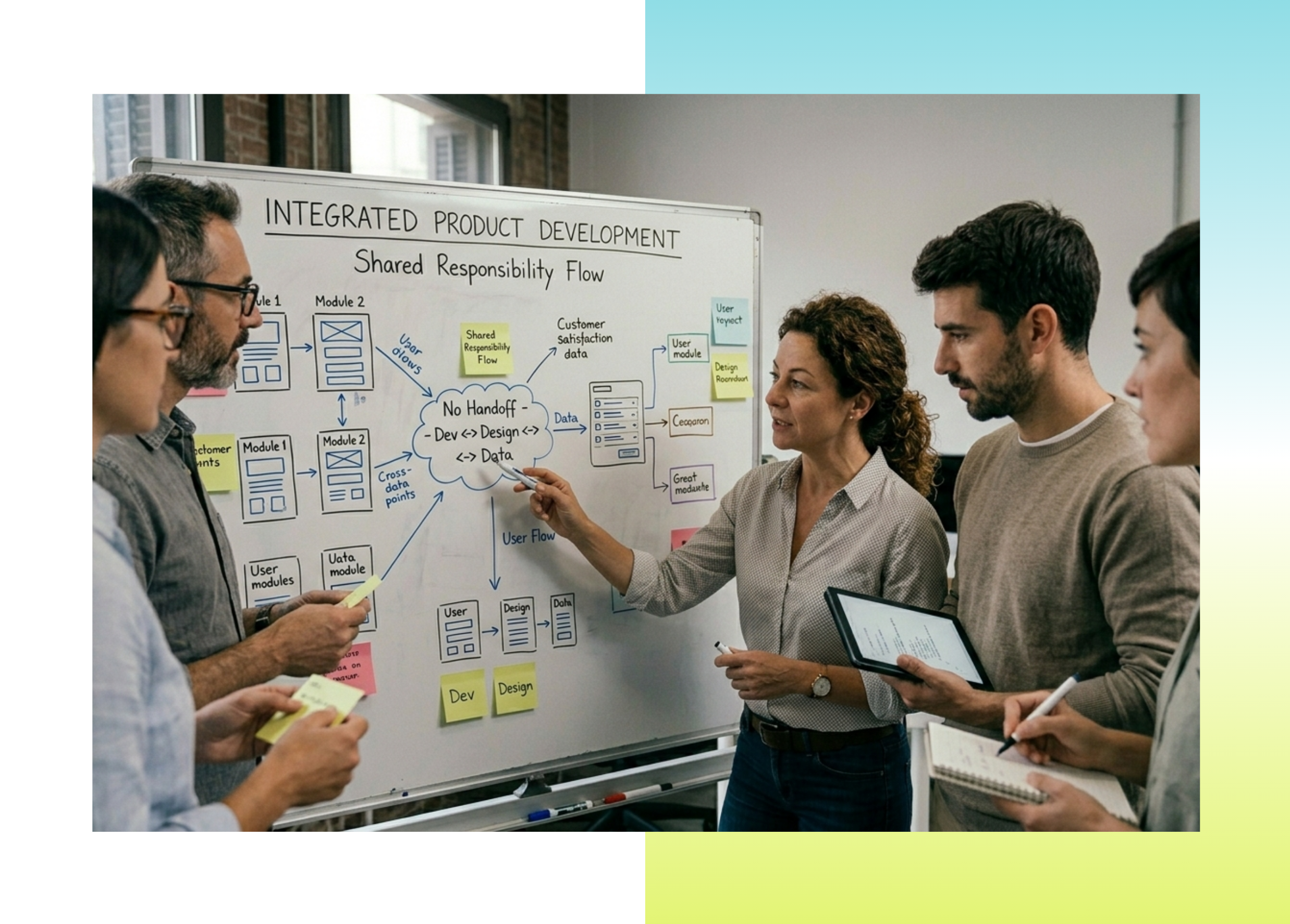
Collaboration replaces handoff documentation with shared understanding built in real time
What the Handoff Actually Costs
The visible cost of the handoff is the time spent producing documentation. A detailed design specification for a non-trivial feature can take one to two weeks to produce at a level of completeness that gives engineers what they need. In a two-week sprint cycle, spending one sprint on documentation for one sprint of development means the design team is running at half the throughput that genuine parallel collaboration would allow. But this is the minor cost. The major cost is the information that is lost in translation between the design artefact and the engineering implementation.
Design documents capture decisions, not reasoning. When an engineer encounters a design decision they do not understand — a specific interaction pattern, an unusual layout choice, a non-standard component behavior — they have two options: interrupt the designer with a question, or make an interpretation call and move forward. In teams where interrupting the designer requires scheduling a meeting or crossing an organizational boundary, the second option is the path of least resistance. Interpretation calls accumulate across a sprint. By the time design reviews the implementation, there are dozens of small divergences from the original intent, each individually defensible but collectively representing a significant drift from the designed experience. The handoff does not prevent misalignment. It simply delays the discovery of misalignment until it is expensive to fix.
Shared Understanding as the Alternative Currency
Lean UX identifies shared understanding as the alternative to documentation-as-handoff. Shared understanding is the collective knowledge that a cross-functional team accumulates when they work on problems together continuously. When an engineer has participated in the user research session that surfaced the problem the feature is solving, has contributed ideas in the Design Studio session that generated the solution direction, and has reviewed early prototypes before they were finalized, they do not need a detailed specification document to implement the design correctly. They already understand the intent. The documentation becomes a reference, not a transfer mechanism.
Building shared understanding requires changing when and how designers engage with engineers. Rather than engaging at the point of handoff — when design is complete and engineering is beginning — shared understanding is built at the beginning of the design process. Designers bring engineers into problem framing conversations. They share user research findings in real time rather than summarizing them in a report. They sketch solutions together in Design Studio sessions. They build clickable prototypes for engineers to interact with before finalizing the design, not after. Each of these touchpoints deposits shared understanding into the team's collective knowledge base. By the time implementation begins, the engineer's mental model of the feature is close enough to the designer's that documentation serves as a checklist rather than a specification.

When engineers participate in design from the beginning, implementation matches inten
What Collaboration Looks Like in Practice
Transitioning from handoff to collaboration requires changes to both process and habit. On the process side, the most important change is integrating design and engineering work into the same sprint rather than staging them in sequential sprints. This does not mean designers and engineers work on identical tasks simultaneously — it means they work on different stages of the same problem in the same sprint, with explicit touchpoints for knowledge exchange. The designer is prototyping a solution for the next feature while the engineer is implementing the current one, and they are having regular conversations about both.
On the habit side, the change is in how designers communicate work in progress. The Lean UX principle of externalizing work — getting ideas out of your head and computer and onto shared surfaces where the whole team can engage with them — is the behavioral foundation of collaborative design. Daily standups where designers share what they are working on and invite input. Shared digital boards where design explorations are visible to the team as they evolve. Brief design reviews where engineers are invited to ask questions and flag implementation concerns before design is finalized, not after. These habits are individually small and collectively transformative. They turn design from something that happens in a separate silo and then arrives as a package to something that the whole team participates in continuously.
How to Advocate for This Change as a Designer
Designers who want to move their organization away from the handoff model are often working against structural inertia: team structures designed around sequential phases, project timelines that assume design precedes engineering, and manager expectations calibrated to the production of deliverables rather than the cultivation of shared understanding. Advocating for change in this context requires patience, strategy, and a willingness to demonstrate the value of collaboration before arguing for it structurally.
The most effective advocacy is a small, visible experiment. Pick one feature, one sprint, one engineering partner. Instead of producing a full specification, schedule a two-hour working session where you and the engineer design the feature together using rough sketches. Then let the engineer implement from those sketches with open access to you for questions. At the end of the sprint, compare the implementation quality, the number of revision cycles required, and the time spent relative to the handoff-based alternative. The evidence from this experiment is more persuasive than any process argument. When engineers say 'that sprint went really well' and when the implementation more accurately reflects the design intent, you have a proof point for a broader change.
The Bottom Line
The handoff is not an immutable law of product development. It is a habit inherited from a manufacturing model that does not apply to software. The shift from handoff to collaboration requires investment — in relationships, in shared process design, in the willingness to work differently than the organization's inertia prefers. But teams that make this investment consistently produce better products with less rework, faster iteration cycles, and higher engineering satisfaction than teams that continue to pass documents over the wall and wait for the inevitable revision cycle.
Related Posts from Sense & Respond Learning
Getting Developers to Care About Users: The Power of 'Exposure Hours'
Facilitating a 'Design Studio': Getting Your Whole Team to Sketch Solutions
Dual-Track Agile: Managing Discovery and Delivery in a Single Sprint
Further Reading & External Resources
Lean UX (3rd Edition) — Jeff Gothelf & Josh Seiden — The foundational text on replacing handoff documentation with shared understanding
Design Is a Job — Mike Monteiro — On the professional responsibility of designers to communicate and collaborate effectively
Articulating Design Decisions — Tom Greever — How to communicate design intent to stakeholders and engineers
Want to go deeper? This post is part of the Sense & Respond Learning resource library — practical frameworks for product managers, transformation leads and executives who want to lead with outcomes, not outputs.
Explore the full library at https://www.senseandrespond.co/blog
